Mixed martial arts has gone from a fringe spectacle to one of the fastest-growing sports in United States of America. If you’ve just watched your first UFC event and spent most of it wondering what was actually happening? you’re not alone. Most people come in knowing someone threw a punch or locked someone’s arm in a painful-looking position, but not much else.
This guide covers everything a new fan needs: what MMA actually is, how it’s different from the UFC, the rules, the fighting styles that matter, the weight classes, and how to start watching without feeling lost. No prior martial arts knowledge needed.
What Does MMA Stand For?
MMA stands for Mixed Martial Arts. A full-contact combat sport where two competitors use striking, kicking, wrestling, and submission techniques drawn from multiple martial arts disciplines. Fights take place inside a fenced cage (most commonly the UFC’s Octagon) and are governed by the Unified Rules of Mixed Martial Arts.
Unlike boxing, which limits fighters to punching, or wrestling, which stays on the ground, MMA allows everything: punches, kicks, elbows, knees, takedowns, and submissions. A fight can start with two fighters trading punches and end 30 seconds later with one of them tapping out from a shoulder lock on the ground.
The sport pulls from boxing, Muay Thai, wrestling, Brazilian jiu-jitsu (BJJ), judo, sambo, and kickboxing. Which is exactly why the word “mixed” is in the name.
What Is the Difference Between MMA and UFC?
This is the single most common question new fans have, and the answer is simple: MMA is the sport. UFC is a company.
Think of it the same way you’d think about basketball and the NBA. Basketball existed long before the NBA, and the NBA is just the most prominent league that runs professional basketball games. Same idea here. MMA is the sport; the UFC (Ultimate Fighting Championship) is the world’s largest organization that promotes MMA events.
The UFC was founded in 1993 and is now owned by TKO Group Holdings. It signs the best fighters in the world to exclusive contracts and puts on events. The fights you see on ESPN and PPV are UFC-produced shows.
But the UFC is not the only MMA organization. Other major promotions include:
Bellator MMA
The second-largest promotion in the US for most of the past decade
ONE Championship
Dominant in Asia, based in Singapore, with a massive roster of world-class fighters
PFL (Professional Fighters League)
Uses a regular-season and playoff format, unique in MMA
Rizin FF
Japan’s top MMA promotion, known for spectacle and big events
MVP (Most Valuable Promotion) by Jake Paul
A fast-rising combat sports promotion focused on high-profile events, crossover fights, and elevating women’s boxing and MMA talent.
| MMA | UFC | |
| What it is | The sport itself | An organization that promotes the sport |
| Where it’s practiced | Worldwide | Based in Las Vegas, Nevada |
| Who governs it | Multiple athletic commissions | Private company (TKO Group Holdings) |
| Who can compete | Any licensed fighter globally | Only fighters under UFC contract |
A Brief History of MMA
Ancient Origins: Pankration and Vale Tudo
The idea of combining different fighting methods isn’t new. Pankration — a combat sport that combined striking and grappling — was part of the ancient Greek Olympics as far back as 648 BC. Athletes used punches, kicks, chokes, and joint locks with almost no restrictions.
In early 20th century Brazil, “Vale Tudo” (Portuguese for “anything goes”) matches pitted fighters from different martial arts backgrounds against each other with minimal rules. These events were brutal and largely underground, but they planted the seeds for what MMA would become.
The Gracie family — particularly Helio and Carlos Gracie — ran challenge matches in Brazil to prove the effectiveness of Brazilian jiu-jitsu against larger opponents from other disciplines. Those matches became legendary in martial arts circles and directly influenced the creation of the UFC.
The Birth of the UFC (1993)
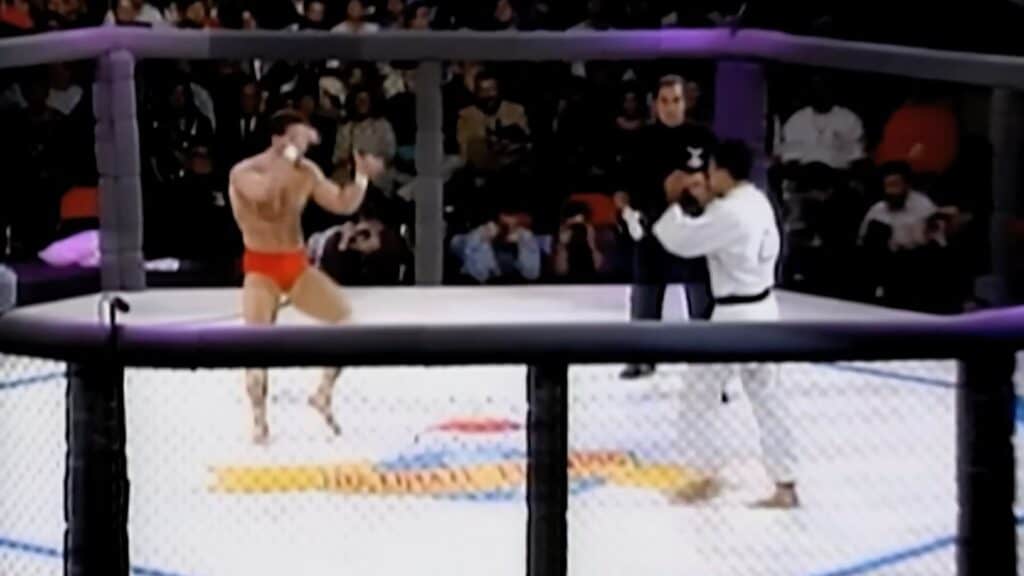
UFC 1 took place on November 12, 1993, in Denver, Colorado. The original premise was simple: take fighters from different disciplines — a boxer, a wrestler, a karate expert, a sumo wrestler — and find out which style actually wins a real fight.
Royce Gracie, a slender BJJ practitioner from the Gracie family, won the tournament and shocked audiences. He submitted fighters who outweighed him by 50+ pounds, and suddenly the world had to take Brazilian jiu-jitsu seriously.
Those early UFC events had almost no rules: no weight classes, no time limits, fighters could fish-hook, headbutt, and groin strike. Senator John McCain famously called it “human cockfighting” and campaigned to have it banned from pay-per-view. Several US states refused to sanction events. The sport nearly died.
The Zuffa Era — How MMA Became a Global Sport
In 2001, brothers Lorenzo and Frank Fertitta, along with their friend Dana White, bought the UFC for $2 million. Under their Zuffa LLC banner, they worked with athletic commissions to establish the Unified Rules of MMA — weight classes, round lengths, a formal list of fouls. The sport became legitimate enough to get licensed state by state.
The game-changing moment came in 2005. The reality show The Ultimate Fighter aired on Spike TV, ending with a live finale that drew massive ratings. MMA went mainstream almost overnight.
Then came the athletes who turned it global: Ronda Rousey, who became a legitimate crossover celebrity and made women’s MMA a commercial product. Conor McGregor, whose trash talk and highlight-reel knockouts made him one of the most recognizable athletes on the planet.
In 2023, the UFC merged with WWE under TKO Group Holdings in a deal valued at $21.4 billion — a figure that would have seemed absurd when the Fertittas bought the company for $2 million two decades earlier.
How Does MMA Work? The Rules Explained
The Octagon and the Cage
UFC fights take place inside the “Octagon” — an eight-sided fenced cage that’s 30 feet across. The canvas floor and padded fence walls are functional, not decorative. The eight-sided shape creates corners that fighters can use for positioning, though they’re softer than traditional boxing ring corners. Pressing an opponent against the fence is a legitimate and common strategy.
Other MMA promotions use different cage shapes. Bellator used a circular cage. Some smaller promotions still use traditional boxing-style rings, though most major organizations prefer cages because they prevent fighters from falling out during grappling.
How Long Is an MMA Fight?
Standard UFC fights run three rounds of five minutes each, with a one-minute rest between rounds. Main events and title fights go five rounds. The clock runs continuously — there are no stoppages for standing up downed fighters or resetting clinches, as you’d see in boxing.
Most fights end before the final bell. Approximately 60–70% of UFC bouts end by finish (KO, TKO, or submission), which is part of why the sport keeps casual viewers hooked.
How Does a UFC Fight End?
Knockout (KO): A fighter is rendered unconscious from strikes. The referee immediately stops the fight.
Technical Knockout (TKO): The fight is stopped while the fighter is still conscious but unable to intelligently defend themselves — they’re taking clean shots with no response. A TKO can also be called if a fighter’s corner throws in the towel to stop the fight.
Submission: One fighter taps out — physically tapping their opponent, the mat, or their own body — to signal they’re giving up, usually to escape a choke or joint lock. A fighter can also verbally submit. Referees also stop the fight if a fighter goes unconscious from a choke.
Decision: The fight goes the full distance. Three judges score each round using the 10-point must system (explained in the FAQ section), and the fighter who wins on at least two of the three scorecards wins by decision.
Disqualification (DQ): A fighter who repeatedly breaks the rules after warnings can be disqualified.
No Contest (NC): The result is overturned, most commonly because a fighter failed a post-fight drug test.
What Are the Rules of MMA?
The Unified Rules of Mixed Martial Arts, adopted by most US athletic commissions, define what’s legal and what isn’t.
Fighters cannot: eye gouge, bite, fish-hook, strike the groin, headbutt, attack the back of the head (called a “rabbit punch”), or strike an opponent’s spine. Downward elbow strikes (“12-to-6 elbows”) are also banned under the Unified Rules, though this specific rule is considered outdated by many in the sport.
The 10-point must system works like this: the winner of each round gets 10 points, the loser gets 9. A judge can award an 8 if one fighter was knocked down or completely dominated. After all rounds, the fighter who wins on at least two of the three scorecards wins by decision.
What Fighting Styles Are Used in MMA?
The “mixed” in mixed martial arts is literal. Elite fighters train in multiple disciplines, and understanding which style someone comes from helps you follow the strategy of every fight.
Striking Disciplines
Boxing covers punching technique, footwork, head movement, and defensive slipping. A fighter with a boxing background tends to be comfortable trading punches at mid-range. Conor McGregor’s southpaw left hand is one of the most recognizable boxing tools in MMA history.
Muay Thai is called “the art of eight limbs” because it uses fists, elbows, knees, and kicks. The clinch — where two fighters hold each other at close range — is central to Muay Thai, and it’s where elbows and knees do the most damage. Muay Thai is the most widely used striking base in MMA today. Anderson Silva and Israel Adesanya built careers on it.
Kickboxing shares DNA with Muay Thai but typically de-emphasizes the clinch in favor of explosive stand-up combinations. Alex Pereira, who holds UFC titles in two weight classes, came from professional kickboxing.
Grappling Disciplines
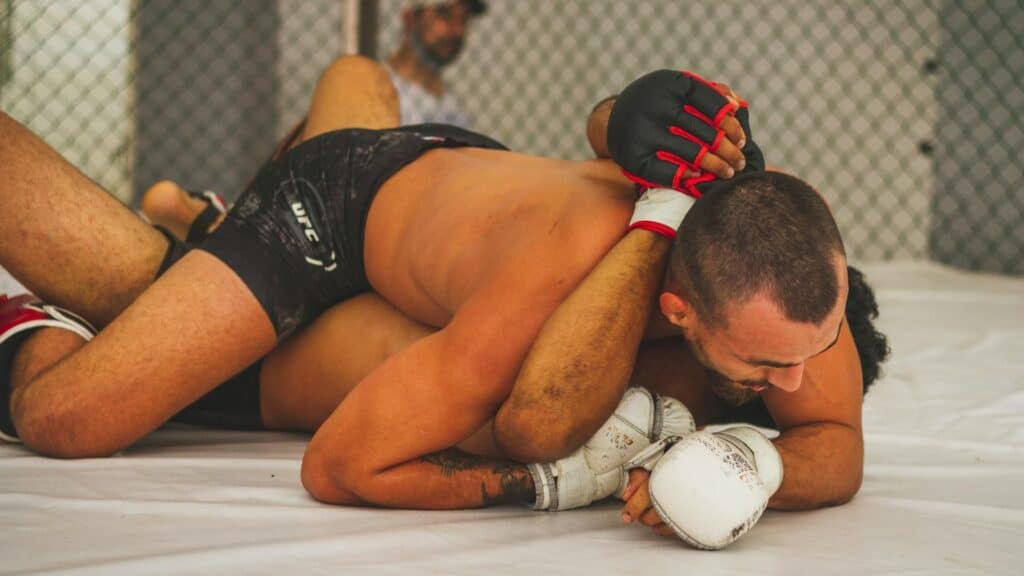
Wrestling determines where the fight takes place. A wrestler can take the fight to the ground when they want to, or keep it standing by defending takedowns. It’s the single most valuable base discipline in UFC history because whoever controls the location of the fight tends to control the fight itself. Khabib Nurmagomedov and Cain Velasquez are the textbook examples.
Brazilian Jiu-Jitsu (BJJ) is ground fighting focused on achieving dominant positions and applying submissions — chokes that cut off blood or air supply, arm locks, leg locks. Charles Oliveira holds the record for the most submission wins in UFC history. Royce Gracie’s dominance at UFC 1 is what put BJJ on the map globally.
Judo uses throws, trips, and sweeps to take opponents from standing to the ground, then transitions to control. Ronda Rousey was an Olympic-level judoka, and her signature move — the armbar — came directly from her judo training.
Sambo is a Russian combat system that blends wrestling-style takedowns with submission grappling. Khabib Nurmagomedov grew up training sambo in Dagestan, and his ground control was unlike anything the UFC had seen at lightweight.
What Is the Best Fighting Style for MMA?
No single discipline wins by itself. The most successful fighters in UFC history are well-rounded — competent strikers who can defend takedowns, and competent grapplers who can handle being struck.
That said, wrestling is widely considered the most valuable starting point because it gives you control over where the fight happens. A skilled wrestler decides whether the fight stays standing or goes to the ground. Without that ability, a purely offensive striker is always vulnerable to a single takedown.
A submission grappler who can’t handle strikes is in trouble the moment the fight stays standing. A boxer who gets taken down and has no ground game is stuck on the bottom. This is why MMA-specific gyms teach all these disciplines together rather than treating them as separate arts.
UFC Weight Classes — How Fighters Are Divided
Weight classes exist so fighters compete against opponents of similar size. Without them, heavier fighters would almost always have an insurmountable advantage.
Men’s UFC Weight Classes
| Division | Weight Limit |
| Strawweight | Up to 115 lbs |
| Flyweight | 116–125 lbs |
| Bantamweight | 126–135 lbs |
| Featherweight | 136–145 lbs |
| Lightweight | 146–155 lbs |
| Welterweight | 156–170 lbs |
| Middleweight | 171–185 lbs |
| Light Heavyweight | 186–205 lbs |
| Heavyweight | 206–265 lbs |
Lightweight (155 lbs) is the most stacked and most watched division in the UFC, with a long history of elite fighters and memorable title reigns.
Women’s UFC Weight Classes
| Division | Weight Limit |
| Strawweight | Up to 115 lbs |
| Flyweight | 116–125 lbs |
| Bantamweight | 126–135 lbs |
| Featherweight | 136–145 lbs |
What Is Weight Cutting in MMA?
Most fighters walk around at a weight significantly higher than their fight weight. In the days before a fight, they dehydrate their bodies — through sweat, sauna sessions, and water restriction — to make the weight limit on the scale, then rehydrate before the fight.
A lightweight might walk around at 175 lbs and cut to 155 lbs for weigh-ins, then come into the cage 10–15 lbs heavier the next day. This gives fighters a size advantage over opponents who stayed leaner. Athletic commissions and the UFC have pushed back against extreme weight cuts due to genuine health risks, but the practice remains widespread.
MMA Glossary — Key Terms Every New Fan Should Know
Octagon — The UFC’s trademarked 8-sided fenced cage, 30 feet in diameter, where UFC fights take place.
Submission — A technique (choke, joint lock) that forces an opponent to tap out or renders them unconscious.
Rear Naked Choke (RNC) — The most common submission in MMA. Applied from behind, it cuts off blood flow to the brain by compressing the carotid arteries. Most fighters go out in seconds if it’s locked in correctly.
Ground and Pound (GnP) — Striking an opponent with punches or elbows while in a dominant ground position, typically from mount or side control.
Takedown — Using wrestling or judo techniques to force an opponent from standing to the ground.
Guard — A ground position where the fighter on the bottom uses their legs to manage the opponent on top. From guard, you can attempt sweeps, submissions, or work back to standing.
Mount — One of the most dominant ground positions. The top fighter sits on the opponent’s torso with their knees on the mat, restricting movement and opening up strikes from above.
Sprawl — A defensive wrestling movement to stop a takedown. When an opponent shoots in to grab your legs, you shoot your hips back and down, neutralizing their attack.
Cage Control — Using the fence strategically — pinning opponents against it, working from the inside, or denying them space. Judges consider it a component of octagon control when scoring.
Pound for Pound (P4P) — A hypothetical ranking comparing fighters across weight classes by skill and dominance, not size. The P4P #1 debate is one of the sport’s most argued topics.
Heel Hook — A leg lock targeting the knee joint by twisting the lower leg. One of the most dangerous and increasingly common submissions in modern MMA.
Southpaw — A fighter who leads with their right hand forward (right foot forward, right hand as the jab). The opposite is “orthodox,” where the left hand leads.
Split Decision — A judges’ decision where the scoring is not unanimous — two judges score for one fighter, one scores for the other. A “unanimous decision” means all three judges agreed.
Interim Title — A temporary championship created when the undisputed champion is injured or otherwise unavailable to compete. Interim champions typically fight the returning champion to unify the belts.
Frequently Asked Questions About MMA
No. MMA (Mixed Martial Arts) is the sport; UFC (Ultimate Fighting Championship) is the world’s largest organization that promotes MMA events. Think of it like the difference between basketball and the NBA. There are other major MMA promotions — including Bellator, ONE Championship, and PFL — but UFC is by far the most well-known.
MMA carries injury risk like all contact sports. Modern MMA has extensive safety protocols: mandatory medical checks before and after fights, referee oversight that stops fights the moment a fighter can’t defend themselves, and ringside physicians who can halt bouts for cuts or injuries. Studies comparing MMA to boxing suggest MMA may actually produce fewer severe head trauma injuries, because fights end faster — a fighter rarely absorbs hundreds of blows the way a boxer in a 12-round decision might.
A standard UFC fight is 3 rounds of 5 minutes each, with a 1-minute rest between rounds. Main event and championship fights are 5 rounds of 5 minutes. About 60–70% of UFC fights end before the judges are needed — only around 30–40% go to a decision.
Tapping out is how a fighter signals submission. They physically tap their opponent’s body, the mat, or their own body to indicate they’re giving up — usually to escape a painful joint lock or a choke that’s cutting off blood or air. A fighter can also verbally submit by saying “tap” or “stop.” The moment a referee sees or hears a submission signal, the fight stops immediately.
TKO stands for Technical Knockout. It happens when the referee stops the fight because a fighter is absorbing significant strikes and can no longer intelligently defend themselves — even if they haven’t been fully knocked out. A TKO is also called if a fighter’s corner throws a towel or steps onto the canvas to stop the fight.
UFC fights are scored using the 10-point must system. The winner of each round gets 10 points, the loser gets 9. A dominant round — involving a knockdown or complete control — can result in a 10-8 score. Three judges each score independently. After all rounds, the fighter who wins on at least two of the three scorecards wins by decision.
Yes. The UFC introduced women’s divisions starting with the Women’s Bantamweight class in 2013, a push driven largely by Ronda Rousey’s mainstream appeal. Today the UFC has four active women’s divisions: Strawweight, Flyweight, Bantamweight, and Featherweight. Amanda Nunes is widely considered the greatest women’s MMA fighter in history — she held titles simultaneously in two weight classes and finished Rousey, Cris Cyborg, and Holly Holm, among others.