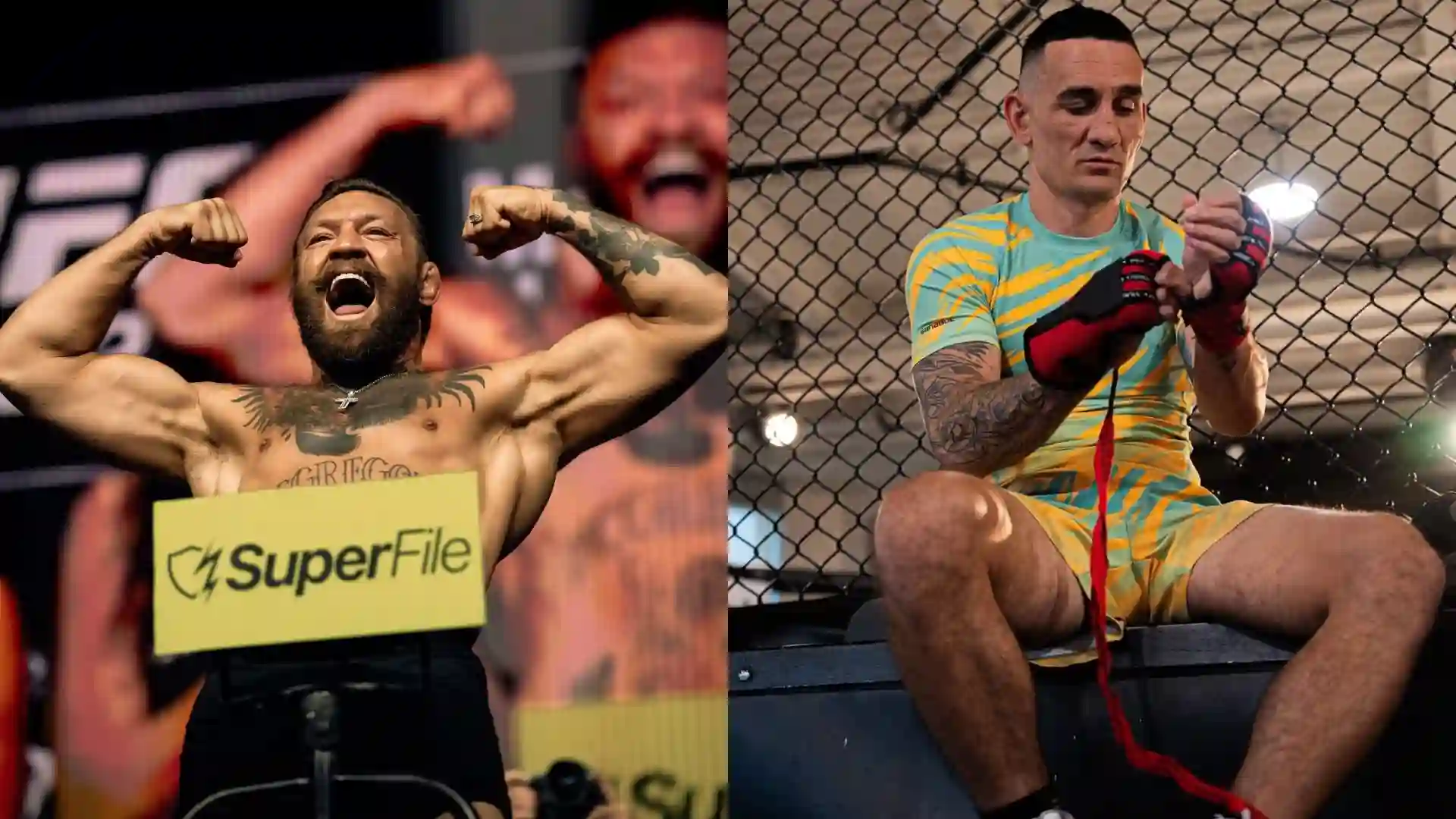
Conor McGregor makes his highly anticipated return to the Octagon tonight against former Featherweight Champion Max Holloway. The two fighters will headline the main event of UFC 329 at T-Mobile Arena in Las Vegas.
The 37-year-old Irishman steps into the cage for the first time since suffering a tibia fracture in July 2021 against ‘The Diamond’ Dustin Poirier.
The Welterweight fight will be a rematch between the two fighters. Previously, McGregor defeated Max Holloway at UFC Fight Night back in 2013 in a Featherweight bout.
This time, Max Holloway enters the contest making his 170-pound, Welterweight debut after proving himself as one of the best strikers at Lightweight. The ‘Blessed’ has remained one of the UFC’s most active stars in recent times, earning victories over top-tier fighters such as Dustin Poirier and Justin Gaethje.
McGregor holds dual-weight championship history but lacks recent activity. The Notorious was inactive for more than three years.
McGregor returns at Welterweight, while Holloway moves up to 170 pounds for the first time. Both men have clear advantages heading into the fight, but they also have questions to answer. Here are three reasons McGregor could win, and three reasons he could come up short at UFC 329.
Why McGregor Could Beat Holloway
1. McGregor’s Knockout Power
The Irish holds 19 knockout wins in his professional mixed martial arts career. A majority of these finishes occurred in the opening two rounds. This early-fight power remains his primary win condition tonight.
The Notorious enters UFC 329 as the naturally larger fighter. He has trained at the Welterweight limit for years, adapting his frame to the 170-pound division. Holloway is moving up from the featherweight and lightweight divisions.
McGregor possesses a 74-inch reach and a signature straight left cross. This physical advantage allows him to control striking distance. “Listen, there’s a different thud when you fight against me,” McGregor said during fight week, referencing the power he believes still separates him from the rest of the division.
Holloway has absorbed heavy damage in recent bouts against elite strikers. If McGregor lands clean combinations early, he has a realistic path to a stoppage.
2. The Notorious’ Counter-Striking Edge
Holloway uses a pressure-heavy style to overwhelm opponents with striking volume. This aggressive forward movement creates openings for counter-strikes. McGregor excels at punishing fighters who step into the pocket.
During their first meeting, McGregor accurately timed Holloway’s entries despite managing a knee injury. Neutralizing Holloway requires intercepting his rhythm. By forcing Holloway to lead the exchanges, McGregor can draw him into overextending. McGregor historically acts on the principle that timing beats speed. His success tonight depends on lateral movement and taking advantage of Holloway’s defensive mistakes during pocket exchanges.
McGregor dismissed Holloway’s approach during the pre-fight press conference. “I find it shows he is here for the economics of it. He must not realize the danger he is in. I forecast Holloway’s retirement on Saturday night,” McGregor stated.
Whether that prediction becomes reality depends largely on McGregor’s ability to make Holloway pay for every forward step.
3. McGregor’s Winning History Against Holloway (2013)
Conor McGregor defeated Holloway in August 2013 by shifting to a grappling-heavy game plan. After tearing his ACL in the second round, McGregor used offensive wrestling to control Holloway on the canvas.
He executed double-leg takedowns and maintained top control. This historical blueprint is a viable tactical option tonight. “I fought against Max many years ago, and I look forward to my improvements on it,” McGregor remarked about the rematch. If striking exchanges become unfavorable, initiating grappling sequences can secure points on the scorecards.
Forcing Holloway to defend takedowns will drain his energy and reduce his aerobic capacity for striking. Integrating offensive wrestling into his strategy could dictate the pace and location of the bout.
Why McGregor Could Lose
1. The Gas Tank (McGregor’s Cardio Concerns)
McGregor’s cardiovascular endurance is his most documented vulnerability. Throughout his UFC career, his performances have been at their best in the opening rounds. His speed, timing, and power make him one of the most dangerous starters the sport has ever seen. But when fights extend into deep waters, the conversation changes. This fade was evident during his loss to Nate Diaz at UFC 196, where muscular fatigue compromised his defense.
Ahead of UFC 329, McGregor expressed reluctance about five-round non-title bouts against Holloway, making endurance a major factor in this 25-minute main event.
Holloway possesses unmatched pace and holds UFC records for Strikes Landed per Minute. He consistently increases his striking output during championship rounds. If the bout extends past ten minutes, Holloway will attempt to overwhelm McGregor. McGregor’s suspect gas tank leaves him vulnerable to late-round volume.
If McGregor hasn’t found a finish by the first 2-3 rounds, the advantage could swing heavily toward Holloway.
2. Octagon Inactivity (McGregor’s Five-Year Layoff)
McGregor has not fought in a professional MMA bout for five years, since July 2021 when he suffered a broken leg against Dustin Poirier. Since then, injuries, recovery, and canceled comeback plans have kept him out of the Octagon.
This extended layoff raises instant questions about his reaction speed and distance management. Training camps are unable to replicate the exact physical demands and timing required in a live UFC fight.
These acute skills frequently degrade during multi-year absences. McGregor insists his camp has been flawless. “The work has been exceptional. No corners cut. No flash. We’ve been quiet this camp, and we’ve been at work,” he told reporters. However, Holloway has remained active against high-level contenders.
McGregor faces severe ring rust against a highly conditioned athlete. If McGregor hesitates early in the first round, Holloway will exploit the timing deficit immediately.
3. The Durability Deficit (Holloway’s Chin)
It took more than 30 UFC fights before anyone put Holloway on the canvas. Ilia Topuria became the first to do it at UFC 308, ending one of the promotion’s most remarkable durability streaks. Even with that loss, Holloway has earned a reputation for taking shots that would stop most fighters.
His defensive shell and physical durability allow him to endure impact and maintain a high-volume brawling style. He actively turns bouts into wars of attrition to break opponents physically. Holloway dismissed any notion of an easy fight against a returning McGregor.“I’m getting ready for the most dangerous Conor McGregor we ever saw. Once you start overlooking people, things don’t go too well for you,” Holloway stated.
This toughness presents a major problem for McGregor. If McGregor lands his best straight left and Holloway remains standing, the fight dynamic alters immediately.
For McGregor, the equation is simple. Landing clean isn’t enough, he has to hurt Holloway. If he can’t slow the former champion’s forward pressure early, he’ll spend the later rounds dealing with one of the UFC’s most relentless offensive fighters.